

Exporting FAQs
Export Certificate Program
ECP1: How do I find out whether the country to which I want to export wine, beer/malt beverages, or distilled spirits produced in the United States requires an export certificate?
Our Import/Export Requirements Guide offers exporters information on some countries’ import requirements for wine, beer/malt beverages, and distilled spirits, including certification requirements for certain countries. The guide also includes information on licensing, labeling, and taxation. Please note that exporters should always contact the responsible foreign agencies (located in the Contacts section of each country page) to verify that the information listed is current.ECP2: Do I need a permit from TTB in order to obtain a TTB export certificate, and if so, how do I obtain a TTB permit?
If you would like to obtain a TTB export certificate, you must have a basic permit, registration, or brewer’s notice on file with TTB. To do this, please send us an application and/or the required documentation for qualification. If you need assistance with determining what type of application to submit, please visit our website TTBGov - Applications for more information. Our Permits Online system allows you to electronically file original applications and amend those applications. To learn more about the Permits Online process, please see our tutorial. Please address any permit questions to the National Revenue Center here.ECP3: How do I obtain an export certificate from TTB for wines, beer/malt beverages, or distilled spirits exported outside of the United States?
TTB’s Export Documents/Certificates webpage provides detailed information about obtaining a paper export certificate from TTB.- For Certificates of Free Sale, Origin and/or Age, Manufacturing, Health, Sanitation, Authenticity, Sanitary Statements/Certificates, and any other certificate that an exporting country requires to be submitted on company letterhead, please use the provided export certificate template.
- For U.S. wine exported to the European Union (EU), the EU requires that your shipment be accompanied by either a simplified export certificate, which is not submitted to TTB for processing, or a VI-1 Long Form (see Wine Exports to the European Union for additional information).
- For U.S. wine exported to economies within the Asia-Pacific Economic Cooperation (APEC) region, with the exception of China, you may consider using the APEC Model Wine Certificate, which includes instructions on completing the certificate. (See below for information on the export certificate accepted by China). This certificate is a consolidation of various export certificates, which includes the Certificate of Authenticity/Free Sale, Certificate of Health/Sanitation, and Certificate of Origin. APEC is comprised of 21 economies: Australia, Brunei Darussalam, Canada, Chile, Taiwan, Hong Kong, Indonesia, Japan, Malaysia, Mexico, New Zealand, Papua New Guinea, the People’s Republic of China (China), Peru, the Republic of Korea, the Republic of the Philippines, the Russian Federation, Singapore, Thailand, the United States of America, and Vietnam. The use and scope of the certificate is at the discretion of the importing APEC economy. For instance, Thailand requires that importers complete the APEC Model Wine Certificate in a particular format, (see APEC Wine Certificate for Thailand for template) otherwise importers must submit samples of their products to Thailand’s Excise Department for analysis. Please contact your importer to ensure that the authorities of the importing economy will accept this certificate in lieu of pre-existing requirements.
- For U.S. wine exported to China, you may submit the consolidated wine export certificate. The certificate incorporates three certificates (Certificate of Origin, Certificate of Health/Sanitation, and Certificate of Authenticity/Free Sale) in one document. If you need a Certificate of Bottling, it must be submitted separately using the export certificate template. Please use the APEC Model Wine Certificate for wine exports to Hong Kong or Taiwan.
- For distilled spirits only:
- Use TTB Form 5110.58 for the Certificate of Origin and Age for Distilled Spirits, if appropriate.
- Use TTB Form 5110.42 for the Certificate of Authenticity Bourbon Whisky.
- Electronically using myTTB;
- Attaching a paper copy using IAD’s online contact form; or
- Submitting a paper copy by mail or commercial carrier.
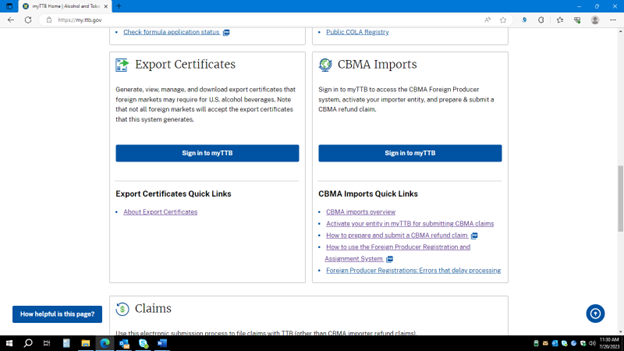 Please note that you will need to activate your entity at myTTB before you can use this system. For information on how to activate your entity, please visit our website TTBGov - myTTB Activate Entity. For information on how to manage an entity, please visit our website TTBGov - myTTB Entity Managers.
IAD’s Contact Form
If you are submitting a paper export certificate, please submit your paper export certificate requests using the IAD contact form, selecting “Export Certificates” as your reason for inquiry and attaching all required documents as a PDF.
By Mail or Commercial Carrier
You may send your paper export certificate requests through the U.S. Postal Service to the following address:
Alcohol and Tobacco Tax and Trade Bureau (TTB)
International Affairs Division
Attn: Export Certificate Program
1310 G St. NW, Box 12
Washington, DC 20005
Return of Export Certificates
If you would like to expedite the return of your paper export certificate, please include a pre-paid shipping label from the carrier of your choice (e.g., the U.S. Postal Service, UPS, FedEx) and attach it to your request. Due to security reasons, we are unable to access any pre-paid shipping labels by hyperlink or URL.
Otherwise, we will return the certificate via the U.S. Postal Service to the return address indicated on your request.
Please note that you will need to activate your entity at myTTB before you can use this system. For information on how to activate your entity, please visit our website TTBGov - myTTB Activate Entity. For information on how to manage an entity, please visit our website TTBGov - myTTB Entity Managers.
IAD’s Contact Form
If you are submitting a paper export certificate, please submit your paper export certificate requests using the IAD contact form, selecting “Export Certificates” as your reason for inquiry and attaching all required documents as a PDF.
By Mail or Commercial Carrier
You may send your paper export certificate requests through the U.S. Postal Service to the following address:
Alcohol and Tobacco Tax and Trade Bureau (TTB)
International Affairs Division
Attn: Export Certificate Program
1310 G St. NW, Box 12
Washington, DC 20005
Return of Export Certificates
If you would like to expedite the return of your paper export certificate, please include a pre-paid shipping label from the carrier of your choice (e.g., the U.S. Postal Service, UPS, FedEx) and attach it to your request. Due to security reasons, we are unable to access any pre-paid shipping labels by hyperlink or URL.
Otherwise, we will return the certificate via the U.S. Postal Service to the return address indicated on your request.
ECP4: How long will it take to obtain an export certificate?
All paper export certificate requests are processed in the order they are received. Our goal is to process paper export certificates within 15 calendar days. Please see ECP10 on ways to avoid delays and ensure your request is processed as quickly as possible. For questions on the status of your request, please contact IAD online using “Export Certificates” as your reason for inquiry or call our office at 202-453-2260. Please include in your message the date, method of submission, and the tracking number for the return shipping label you provided (if applicable).ECP5: Does each alcohol beverage need an individual export certificate?
Generally, each shipment should have a separate export certificate. Typically, one certificate can cover several different products, as long as they are in the same shipment. Our Import/Export Requirements Guide offers exporters information on some countries’ import requirements for wine, beer/malt beverages, and distilled spirits, including certification requirements for certain countries that may vary from the general guidance above. Exporters should always contact the responsible foreign agencies (located in the Contacts section of each country page) to verify that the information listed is current.ECP6: I am exporting wine to the European Union (EU). What type of certificates are required?
U.S. wine exported to the EU must be accompanied by either a simplified export certificate or a VI-1 form for each type and/or lot of grape wine. EU Simplified Export Certificate (self-certifying)- Producing wineries that are also the exporter may use the simplified export certificate, which only requires one chemical analysis of the wine (actual alcohol content) and is self-certified by the exporter. (See TTB Industry Circular 2007-02 for additional information, including a sample certificate.)
- Producing wineries that are also the exporter may use the VI-1 short form once they are added to the official EU list of self-certifying wineries published in the EU Official Journal. To be added to the EU list, the producing winery must first fill out an Attachment IV certification statement and submit the completed form to TTB using the IAD contact form, selecting “Export Certificates” as your reason for inquiry. TTB provides the EU with any new submissions twice a year, in March and September. Once a winery has been added to the EU’s official list, they may begin using the VI-1 short form for exports to the EU.
- Wholesale Basic Permit Holders, which are not the producer of the wine (producing winery), must use the VI-1 Long Form. The Long Form also may be used by any U.S. exporter (i.e., producing wineries and/or wholesale basic permit holders).
ECP7: I need a chemical analysis of the product. Where can I find a list of approved chemists?
You can find a list of chemists certified by TTB for the analysis of exported alcohol products on our Chemist Certification Program Information Web page.ECP8: What is an apostille and how do I obtain one?
An apostille is a certificate issued by a designated authority in a country where the Hague Convention Abolishing the Requirement for Legalization of Foreign Public Documents (Convention) is in force. Some countries may request an apostille to authenticate the seals and signatures of officials on public documents so that they can be recognized in foreign countries that are parties to the Convention. In the United States, federal executive branch documents are authenticated by the U.S. Department of State Office of Authentications. The Office of Authentications completes apostilles for documents signed by TTB, such as export certificates. The exporter will need to first obtain the export certificate from TTB and then submit the certificate processed by TTB to the Office of Authentications for an apostille. Details on the apostille process are available at Office of Authentications (state.gov).ECP9: Can I submit requests for export certificates electronically?
Yes, we prefer that you use TTB’s electronic export certificate system at myTTB to prepare and manage your export certificates. You also may submit paper export certificate requests using the IAD contact form, selecting “Export Certificates” as your reason for inquiry. Please see ECP10 on ways to avoid delays and ensure your request is processed as quickly as possible.ECP10: What can I do to ensure that my paper export certificates will be processed by TTB as quickly as possible?
You can help us process your export certificate request expeditiously by following these tips:- Permit - Please ensure that the correct TTB permit, registry, or brewer’s notice number is provided on the certificate for the company listed. See ECP2 on how to obtain a permit, registry, or brewer’s notice number.
- Signature - If using TTB’s export certificate template, please ensure both pages in the template are signed.
- Include the typed name and position of the person signing the document after or below the signature on certificates submitted on your company’s letterhead.
- Ensure that the person signing the export certificate request has signing authority or power of attorney for the company on file with TTB. This is the most common reason for delay.
- The Certificate of Origin and Analysis must include the chemist’s printed or typed name below the signature so that we can verify that the chemist is a TTB-certified chemist.
- Type of Certificate - Please use the appropriate export certificate template provided on the TTB export documents webpage, unless otherwise required by the importing country.
- Fill in all of the requested information in the template.
- The premise address listed on the export certificate must match the address on file with your permit with TTB. If your premise address has changed, you must apply for and receive an approved amended permit prior to conducting operations.
- If using the export certificate template, please ensure you submit two signed copies of your request(s); one should appear with your company letterhead on top, and a second copy should appear on TTB letterhead.
- Foreign Importer/Consignee Information - The name and address (i.e., street, city, and state), listed on the export certificate must be complete.
- Return Shipping - Please include a prepaid shipping label from the carrier of your choice with your submission if you would like to be able to track your documents and receive an expected delivery date.
- Please include your prepaid shipping label with your export certificate submission. We cannot guarantee that prepaid shipping labels sent separately from the export certificates will be used with the correct export certificate. Please see ECP3 for additional information on submitting your export certificates.
- Otherwise, we will return the certificate through the U.S. Postal Service. Please ensure you include a mailing address to which you wish to have your export certificates returned.